
If your pipes may be frozen, do not spend the call trying to diagnose the exact blockage. Tell the plumber where you are, which taps or appliances have lost water, when it started, whether you can see damage, and whether you have turned off the water supply. Those details help them judge how urgent the situation is and advise you safely before they arrive.
The biggest risk is not always the frozen section itself. A pipe can split while frozen, then begin leaking only as it thaws. A clear, factual call is often the fastest way to protect the property.
What to tell a plumber about frozen pipes
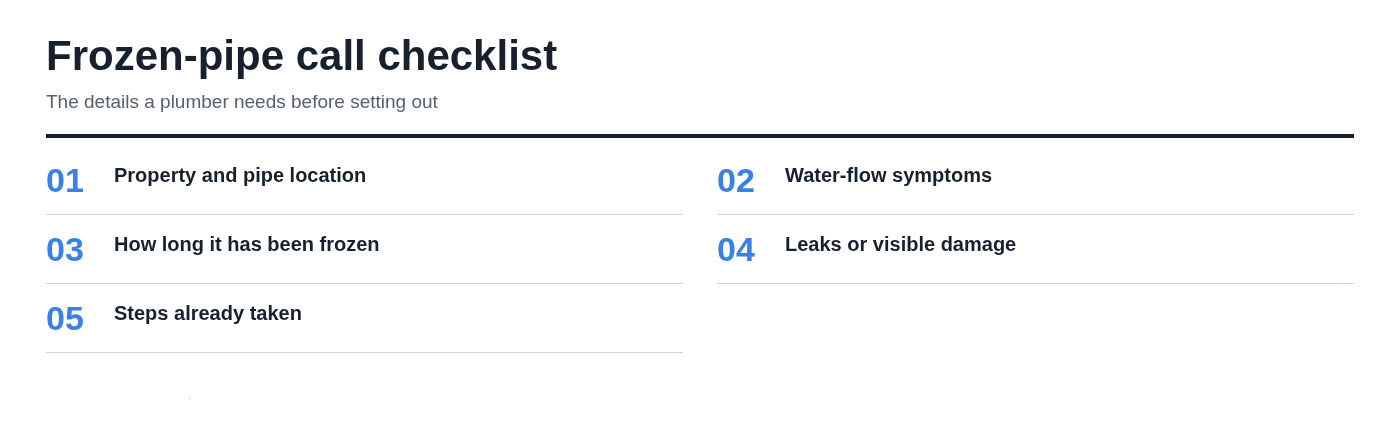
Start with five essentials: the property and suspected pipe location, the water-flow symptoms, how long the issue has been present, any signs of a leak or burst, and what you have already done. A plumber does not need a perfect diagnosis from you; they need reliable observations.
Giving this information upfront helps them assess whether you need urgent help, what equipment may be needed, and whether you should isolate the water supply or take other immediate steps. It also avoids wasting time on vague descriptions such as "the pipes are frozen somewhere."
A simple way to open the call is: "I am at [address]. We have [no water/reduced flow] at [affected taps or appliance]. It started around [time or day]. I think the problem may be near [location], and [there are/are no] visible leaks. The stop valve is [accessible/not accessible], and I have already [safe action taken]."
Start with the property and suspected pipe location
Give the full address first, then explain the type of property: flat, terraced house, detached home, converted building, rental property, or vacant home. Mention whether someone is currently in the property and whether you can access the main stop valve. If you are unsure where it is, see How to Find the Internal Stopcock in Your Home.
Next, share your best clue about the location. Frozen pipes are often found in unheated or exposed areas, including lofts, garages, cellars, utility rooms, under-sink cupboards, outside-facing walls, and unheated extensions. If the water loss affects a kitchen tap beside an external wall, say so. If it began after a cold night in a property with an unheated loft, that is useful context too.
You do not need to identify the exact pipe. In fact, guessing can be less helpful than reporting which fixtures are affected. For example, "The downstairs kitchen cold tap has no water, but the bathroom taps work normally" gives a plumber a far better starting point than "I think it is the pipe under the floor."
Describe exactly what the water is doing
Be precise about whether there is no water, a weak trickle, intermittent flow, or normal flow from some fixtures but not others. Also say whether the problem affects cold water, hot water, or both.
A cold-water-only issue may point to a frozen supply pipe. If only hot taps are affected, the cause may be related to the heating or hot-water system instead. Do not assume every loss of water in freezing weather is a frozen pipe.
It is also worth checking whether neighbours have normal water service. If nearby properties have no water too, the issue could be connected to a wider supply interruption rather than your internal plumbing. Tell the plumber what you have found, but do not delay seeking help if there are signs of damage inside your home.
If pipes freeze and there is no water, avoid repeatedly turning taps on and off or forcing fittings. If you are attempting a safe thaw of an accessible pipe, a plumber may advise leaving the affected tap open slightly so melting ice and pressure can escape. Do this only when it is safe and appropriate for the situation, and get professional guidance when the frozen area is uncertain, concealed, or inaccessible.
Tell them when the problem started and how long the pipes may have been frozen
Timing matters. Tell the plumber when you first noticed poor flow or no water, how cold conditions have been recently, and whether the issue followed a heating failure, power outage, or change in thermostat settings.
If the property has been empty, say how long it was unoccupied and whether the heating was left on. A vacant property with no heat for several days presents a different risk from an occupied home where one exposed pipe froze overnight.
Pipes frozen for 2 days deserve prompt professional advice. The longer a pipe remains frozen, the harder it can be to know whether it has cracked behind a wall or under a floor. The damage may not become obvious until temperatures rise and water begins to move again. Prolonged DIY heating is not a substitute for a proper assessment when water has been off for an extended period.
Also mention any boiler fault, loss of electricity, or recent heating-system work. These details can help separate a local frozen-pipe problem from a broader issue affecting heat or hot water.
Report warning signs of a leak or burst pipe immediately
Tell the plumber straight away if there is any evidence of escaping water. A frozen pipe becomes an emergency when it is leaking, split, bulging, or creating a flooding risk. For more signs to watch for, see the signs of a hidden water leak in your home.
- Dripping water, pooling water, or water running from a wall, ceiling, or floor
- Damp patches, new water stains, or a sagging ceiling
- Hissing sounds near pipework
- Visible cracks, bulges, or distorted pipework
- An unexpectedly moving water meter when no taps are in use
- Water close to sockets, appliances, consumer units, or other electrical equipment
Say whether you have shut off the main water supply and whether you can still do so. If a pipe has burst or water is entering the property, turn off the stop valve if it is safe to reach. Do not wade through water to access it, especially where electricity may be involved.
If water is near electrics, there is major flooding, or you cannot safely isolate the supply, treat it as an emergency and follow applicable local emergency guidance as well as contacting a plumber.
Explain what you have already tried - and what not to try next
Tell the plumber every safe step you have already taken. This prevents duplicated troubleshooting and helps them understand whether a pipe has been warmed, disturbed, or exposed to sudden temperature changes.
Useful details include whether you have raised the heating, opened cupboard doors beneath sinks, placed warm towels around an accessible pipe, or used a hairdryer at a safe distance. Also report whether you have turned off the water supply or noticed any change in flow after trying these measures.
Do not use a blowtorch, naked flame, heat gun at close range, or boiling water. These methods can damage plastic fittings, stress metal pipework, start a fire, or cause steam burns. Never attempt to thaw a pipe near standing water, damaged electrical equipment, or an area you cannot access safely.
If you have already tried an unsafe method, be honest about it. The point is not to be judged; it is to help the plumber account for possible heat damage and deal with the remaining risk properly.
How to find a frozen pipe without causing more damage
You can narrow down the likely area, but you should not dismantle your home to prove where the freeze is. Start by listing every affected tap, toilet, shower, washing machine feed, or outside tap, then compare them with fixtures that still work.
Trace any accessible pipework back from the affected fixture, particularly through cold areas and along external walls. Frost, a bulge, or a section that feels unusually cold can be a clue. Avoid handling pipework roughly or forcing valves and fittings that may be under pressure.
Many frozen sections are concealed in wall cavities, floor voids, loft spaces, or behind kitchen units. Do not cut into plasterboard, lift fixed flooring, or remove pipe fittings to find the problem. A concealed pipe may be damaged, and opening up finishes can make an already stressful situation more expensive.
Call a plumber when the suspected location is hidden, difficult to reach, or cannot be warmed safely. Accurate symptoms and accessible clues are enough for a professional to begin the investigation.
When frozen pipes need urgent plumbing help
You should worry about frozen pipes immediately if there is a leak, a burst pipe, bulging pipework, flooding risk, water near electrics, or no safe way to shut off the water. The same is true when a household has no heat or no water and includes vulnerable occupants, young children, or people who depend on water for medical or care needs.
A same-day call is sensible when water flow has stopped or significantly reduced, the pipe may have been frozen for more than a day, the property has been unheated, or you cannot locate the affected section. Waiting for a pipe to thaw on its own can mean waiting to discover a crack after substantial damage has started. When comparing local options, use this guide to find a plumber and check availability for a suspected frozen pipe.
There are situations that may be monitored, but they still need attention. If water flow is currently normal, there are no marks or leaks, and the issue was limited to a brief cold spell, protect exposed areas and keep an eye on the property. Do not take normal flow as proof that there is no damage; inspect accessible pipework as conditions warm.
Use this short frozen-pipe call script
Use this script when you contact a plumber:
"Hello, I am at [full address] in a [property type]. We have [no water/low water/intermittent water] at [list affected taps, appliances, or rooms]. It started [time and date], after [cold weather/heating failure/power outage/property being empty]. I think the affected pipe may be near [accessible location or external wall], but I am not certain. There [are/are no] signs of leaking, staining, dripping, bulging, or water near electrics. The main stop valve is [accessible/not accessible], and I have [shut it off/not shut it off]. So far, I have tried [safe measures already taken]."
If relevant, add these practical details before the plumber sets out:
- Clear photos of accessible pipework, damp patches, or visible damage
- Whether the boiler and heating are working normally
- Whether anyone is in the property and able to provide access
- Parking, gate, flat-entry, or access-code restrictions
- Whether the water supply has been isolated successfully
Do not worry if you cannot identify the frozen pipe. "The kitchen cold tap stopped, but the bathroom is fine" is useful information. A confident but incorrect guess about a hidden pipe is not.
Make the call with the right details, then protect the property
The essential information is simple: where the property is, what water is or is not flowing, when the problem began, whether there are signs of damage, whether the stop valve is accessible, and what safe actions you have already taken. With those facts, a plumber can make a better urgency decision and give more useful instructions.
While waiting, keep monitoring for leaks, avoid unsafe thawing methods, and isolate the water supply if a leak develops and it is safe to do so. If you need help finding local contact options, BestPlumber can help you look for plumbers in your area.