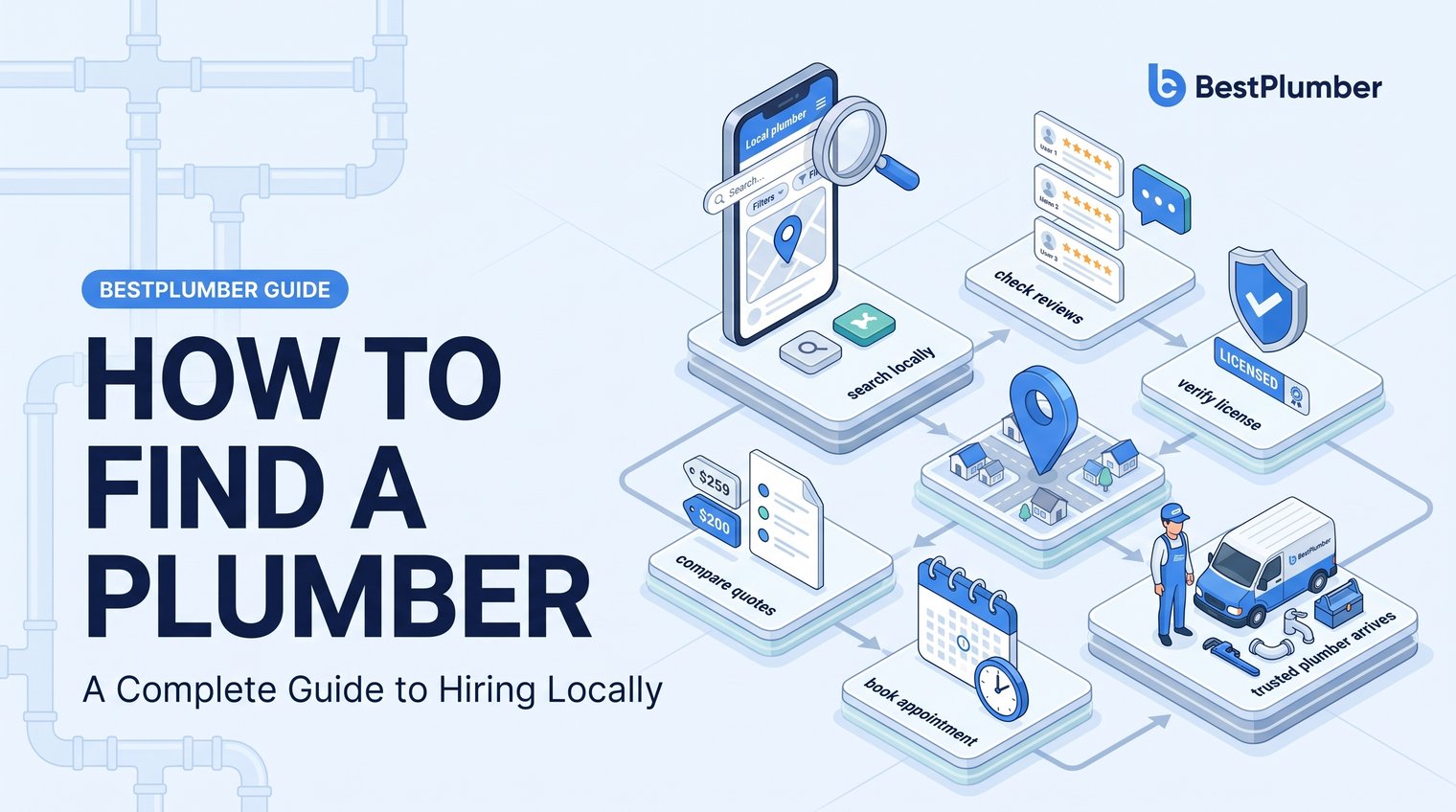
A plumbing problem becomes expensive when the search for help is rushed. A leaking pipe, failed boiler or blocked drain can make anyone type "find a plumber near me" and call the first number available. That is understandable, but it is not always the safest or best-value choice.
A better approach is simple: establish how urgent the problem is, identify the type of professional required, compare a small local shortlist, and get the important terms in writing. This guide walks through that process so you can hire with more confidence, whether you need a plumber for a small repair or a larger home project. The gas-registration and emergency gas guidance here applies to the UK; elsewhere, follow local requirements.
Start with the plumbing problem, urgency and property details
Before contacting anyone, get clear on what has happened and what you need the person to do. A plumber can give a more useful initial response when you describe the symptoms, where they are occurring and whether the issue is getting worse.
Separate an active emergency from work that can be scheduled. Water pouring from a burst pipe needs immediate attention; a dripping tap or slow-draining basin usually does not. This distinction affects who you contact, how quickly they can attend and whether emergency pricing may apply.
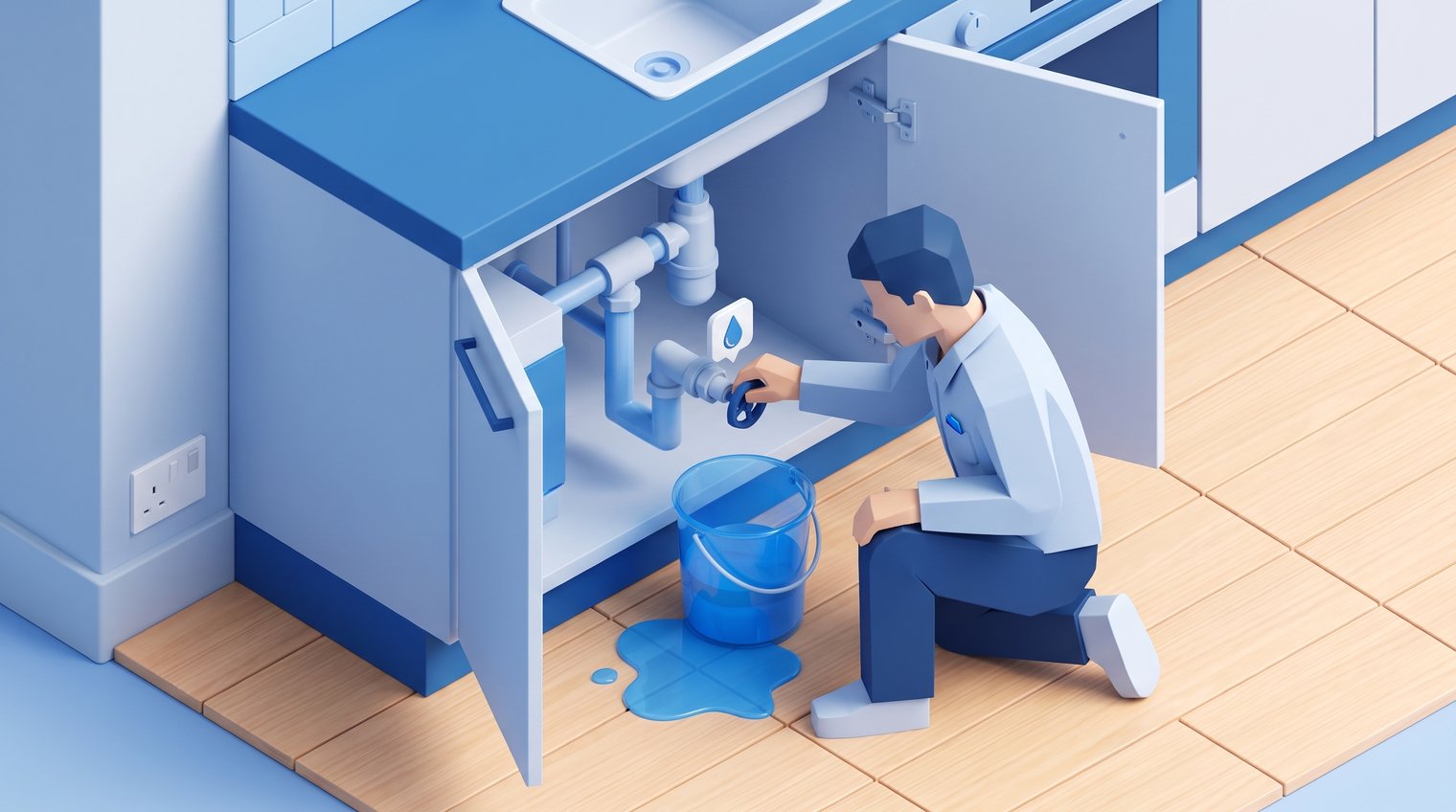
Do not attempt repairs that put you at risk. If it is safe and you know where the internal stopcock is, turning off the water supply can limit damage from a serious leak. Avoid forcing valves, removing electrical covers or working around standing water near electrical equipment.
Quick-start: find and book a suitable local plumber
- Make the situation as safe as possible. Contain water, move valuables and isolate the water supply only if you can do so safely.
- Write down the symptoms, when they began, the location and any relevant appliance or boiler model details.
- Search locally by town, postcode or practical travel radius rather than relying on one result.
- Check that the professional is appropriate for the work, especially for gas, heating and specialist drainage jobs.
- Ask about availability, call-out terms and how their estimate or quote process works.
- For planned work, compare written responses from suitable candidates before confirming a booking.
- Confirm the appointment, agreed scope and approval process for any additional work.
For urgent work, speed matters, but it should not replace basic checks. You may need to prioritise the plumber who can attend safely and promptly, then confirm costs and credentials before work begins where practical.
Emergency signs that call for immediate help
Seek urgent plumbing assistance for an uncontrollable leak, burst pipe, sewage backup, major overflow or loss of water that appears to affect the property supply. If water is escaping quickly, protect people first, then reduce damage by moving belongings and shutting off the supply only if you know how.
Gas concerns are different. If you smell gas, suspect a gas leak or have concerns about carbon monoxide, follow emergency gas safety guidance and contact the emergency gas service rather than treating it as an ordinary plumbing call-out. Do not use flames, operate electrical switches or try to diagnose the issue yourself.
A boiler fault without a gas smell may require a suitably registered heating engineer, particularly if it affects heating or hot water. As covered later, gas appliances and gas boiler work require a professional with the right Gas Safe registration for the work involved.
Know which type of plumber you need
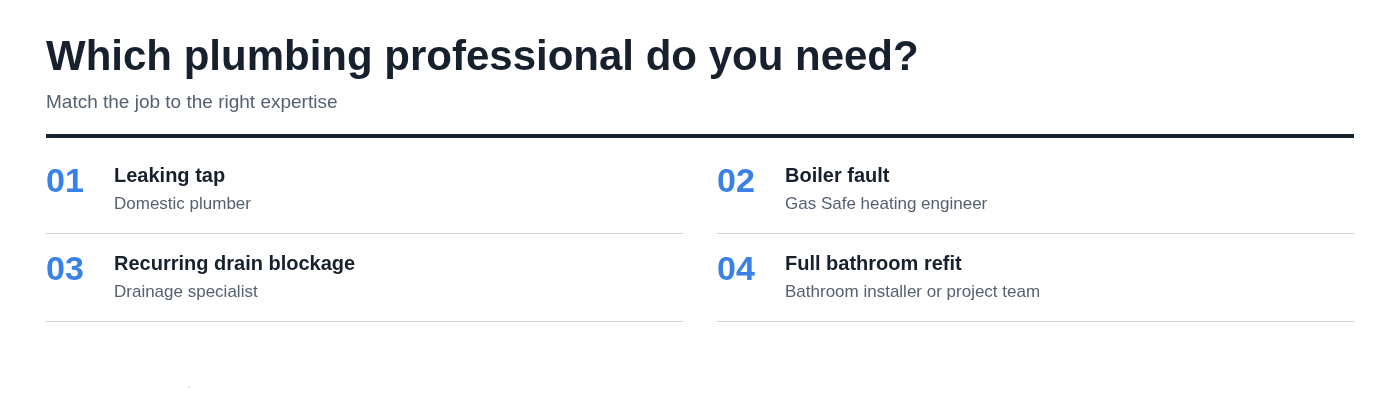
"Plumber" covers several kinds of work. Choosing the right trade at the beginning prevents wasted call-outs and improves the chance that the person arriving has the tools, qualifications and experience needed for your job.
Domestic repair and small-job plumbers
For common household repairs, a domestic plumber is often the right starting point. Typical work includes leaking taps, running toilets, damaged pipework, faulty valves, minor leaks, shower problems and some appliance connections.
People often search for plumbers near me for small jobs because the repair looks too minor for a large contractor. That is a reasonable approach, but be specific about the scope. A loose tap may be a straightforward fitting issue; a recurring leak under a kitchen sink may involve failed pipework, water damage or an appliance connection that needs more investigation.
When making an enquiry, state whether the job is a repair, replacement or investigation. If you already have a replacement tap, toilet part or appliance ready to fit, say so. The plumber still needs to confirm compatibility and condition on site.
Heating and gas engineers
Boilers, central heating, radiators, gas hobs, gas fires and other gas appliances need the right expertise. In the UK, gas work must be carried out by an appropriately Gas Safe registered engineer.
Do not assume that every plumber carries out gas work, or that every Gas Safe registered engineer is qualified for every gas appliance. The registration needs to cover the type of appliance and work required. For example, a boiler issue, gas cooker connection and commercial appliance job may involve different categories.
Drainage, bathroom and larger-project specialists
Recurring blockages, suspected drain damage and problems beyond the internal plumbing system may call for a drainage specialist. Drain surveys, drain jetting and work involving external pipes are often best handled by someone who routinely diagnoses those issues.
A full bathroom refit is also different from replacing a tap. It can involve plumbing, tiling, electrics, ventilation, joinery and finishing work. A bathroom installer or coordinated project team may be better placed to manage the sequence of trades, specifications and responsibility for the completed room.
Build a local shortlist without relying on the first result
Being nearby is useful, but proximity alone does not make someone suitable. The best local choice balances travel distance with relevant experience, genuine availability, clear communication and transparent pricing.
For planned work, aim to identify three plausible candidates. That is usually enough to compare approaches without turning a straightforward repair into a week-long research project. For an urgent problem, focus first on suitable professionals who can attend within the needed timeframe.
Use directories, recommendations and targeted local searches
Start with a local directory, ask trusted neighbours or property contacts for recommendations, and run targeted searches using your town or postcode. Searches such as "plumbers near me within 10 mi" can be useful in a built-up area, while a wider search may be needed in rural locations or for specialist work.
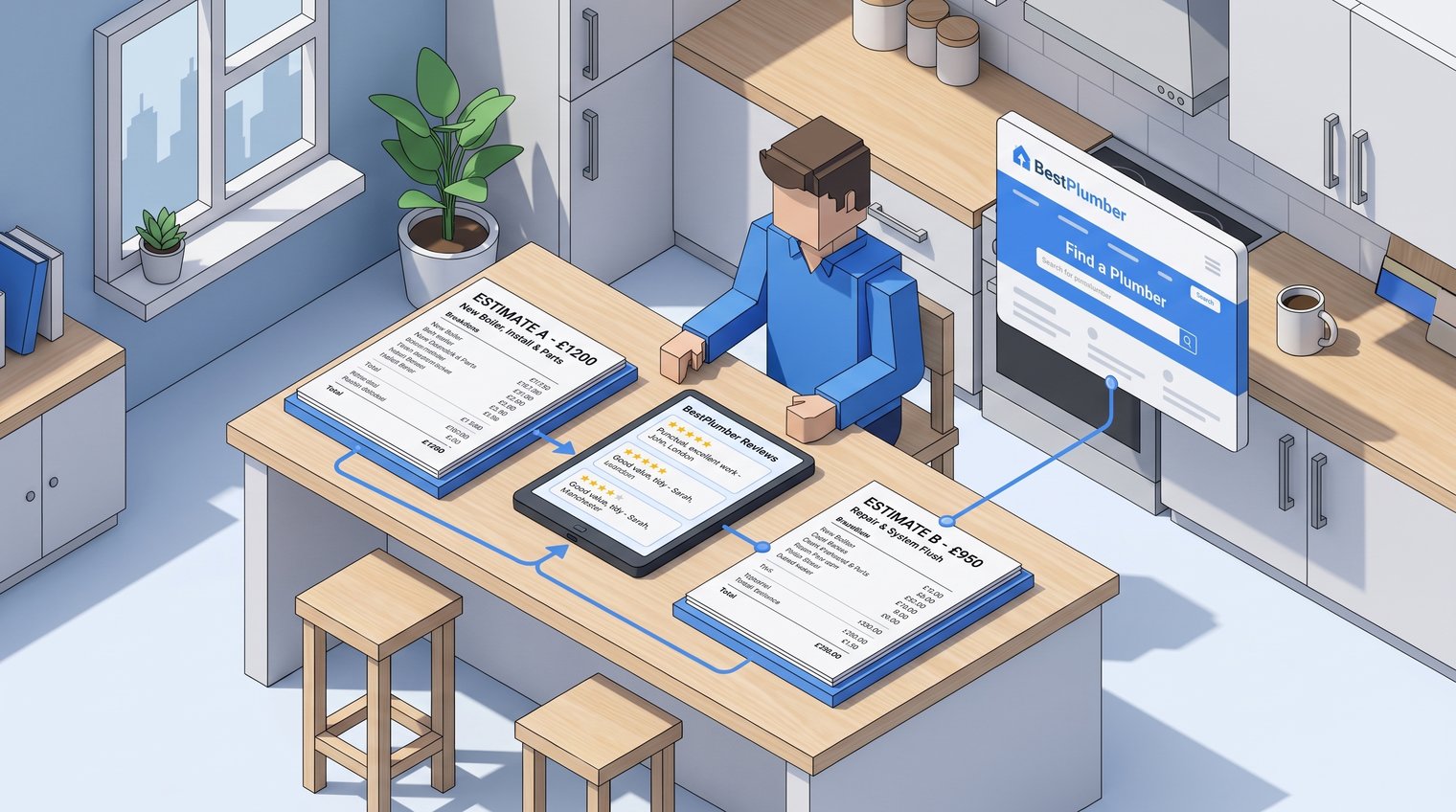
BestPlumber can be a practical location-based starting point when you want to find local plumber contact options by area. Use it to build a shortlist, then carry out your own checks on availability, job fit, credentials and written terms before hiring.
A recommendation is valuable when it is specific. "They were good" tells you little; "they diagnosed a recurring shower leak, explained the options and returned to fix it on the agreed date" is more useful evidence. Ask what work was done, how recently it happened and whether the person would hire them again for a similar job.
BestPlumber
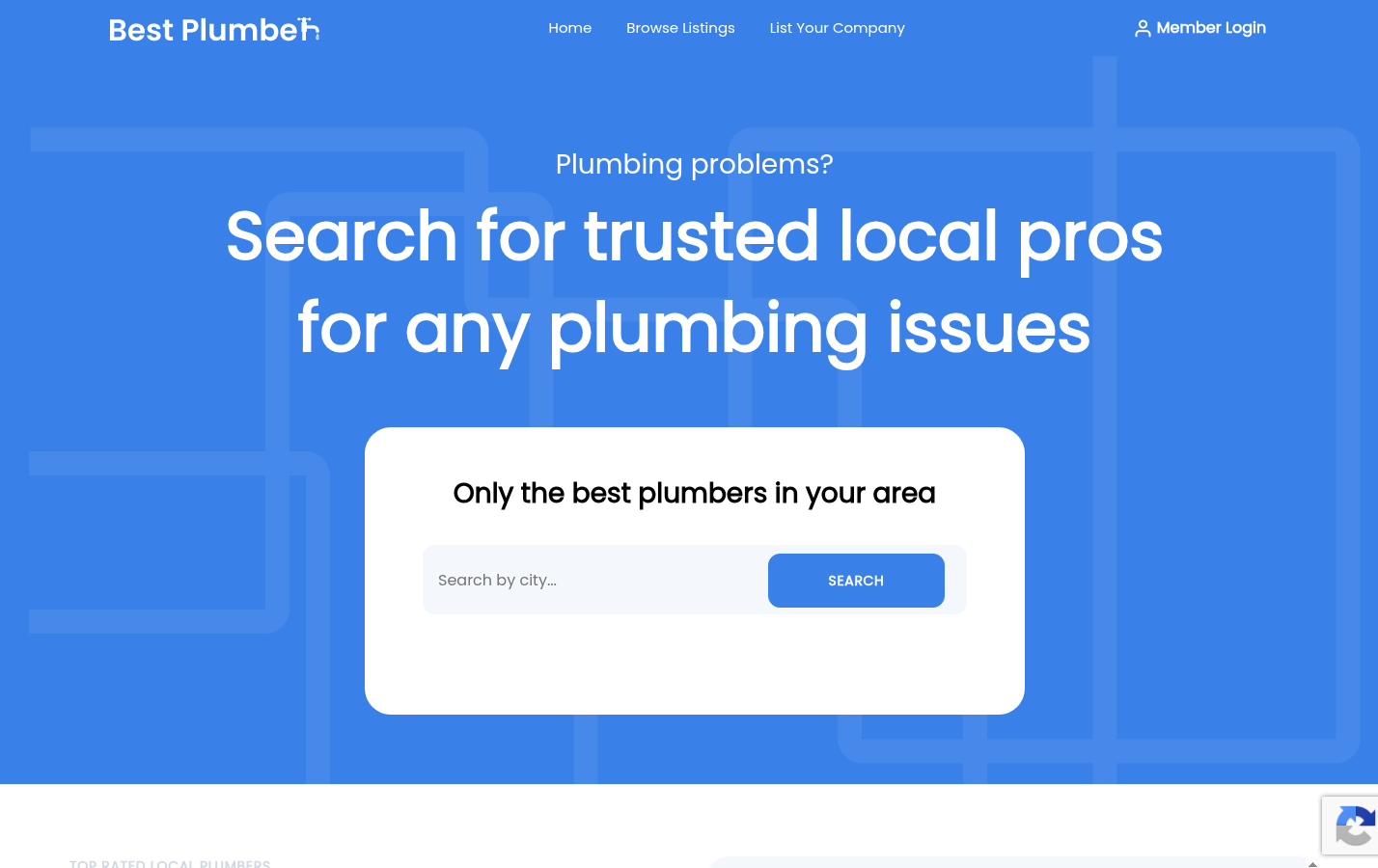
BestPlumber is most useful for beginning a local search when you need to identify plumbers by city or area and make direct enquiries. Where shown, compare location, service relevance and contact details before making an enquiry. It is a discovery and contact directory, rather than a contractor that performs the work or an emergency dispatch service.
That distinction matters. A directory can help you avoid starting from a blank page, but it cannot replace the hiring checks in this guide. Review the listing details, contact the provider with a clear job brief, and verify any credentials relevant to your particular work.
Choose this route when location is your first filter and you want a practical list of local contact options. For a boiler, gas appliance or complex project, use the shortlist as the start of your due diligence, not the end of it.
Widen the radius only when the job justifies it
Searching for plumbers near me within 30 miles can make sense for specialist drainage work, a particular heating system, rural properties or a larger bathroom project. It may also be necessary if local availability is limited.
The trade-off is cost and response time. Ask whether travel time, mileage, parking or an out-of-area call-out charge is included. A provider from farther away may still be the better option for a specialist job, but only if the extra travel cost and attendance window are clear before you agree.
Check the credentials that matter for your job
Credentials are not a marketing detail. They are a way to reduce risk, especially where gas, heating systems, specialist installations or costly work are involved. Check current information directly rather than treating a badge in an advert as proof.
Your basic checklist should include the business name and contact details, the individual attending where relevant, public liability insurance, qualifications appropriate to the job, and current Gas Safe registration for gas work. Membership of a trade association may be a positive sign, but it is supplementary evidence rather than a guarantee of workmanship.
Verify Gas Safe registration for any gas work
For a gas boiler, gas appliance or gas pipework job, check the engineer on the official Gas Safe Register before work starts. Confirm both the engineer's registration and the appliance or work categories that apply to your job.
This is a pass-or-fail requirement, not a point to negotiate. A general plumbing qualification, a positive recommendation or a low price does not substitute for appropriate Gas Safe registration. Conversely, routine non-gas plumbing work does not automatically require a Gas Safe engineer.
Assess insurance, qualifications and business traceability
Public liability insurance can help show that a business has considered the risks of working in customers' homes, but it does not prove technical competence or guarantee a perfect result. Ask what insurance they hold if the scale of the work makes it relevant, particularly for larger installations or property-sensitive jobs.
Clear business details matter too. You should be able to retain a name, phone number, email address, written scope and invoice details. If a problem occurs later, those records make it easier to request warranty work, clarify what was agreed or raise a complaint.
Read reviews and references like evidence, not star ratings
Star ratings can help you spot a broad pattern, but detailed, recent reviews are far more useful. Look for feedback on the same kind of work you need, as well as punctuality, communication, cleanliness, diagnosis, pricing clarity and how problems were resolved.
A plumber who consistently receives comments about explaining options and leaving a tidy work area may be a better fit for a bathroom installation than one with a high rating based only on quick emergency call-outs. Context matters.
Be cautious when reviews have identical phrasing, appear in an unusually sudden cluster, contain no job detail or reveal a repeated unresolved complaint. One unhappy customer is not conclusive. A pattern of surprise charges, missed appointments or ignored follow-up is a stronger reason to look elsewhere.
Ask for relevant examples on larger or specialist work
For bathroom refits, heating changes, recurring drainage faults or substantial pipework, ask for examples of comparable work. You are not looking for polished sales material alone; you want evidence that the provider has dealt with similar technical and practical constraints.
If references are offered, ask whether the customer has agreed to be contacted and keep the questions focused. Was the scope clear? Did the work stay close to the agreed price? How were changes handled? Has the work performed as expected since completion?
Describe the job clearly to get comparable responses
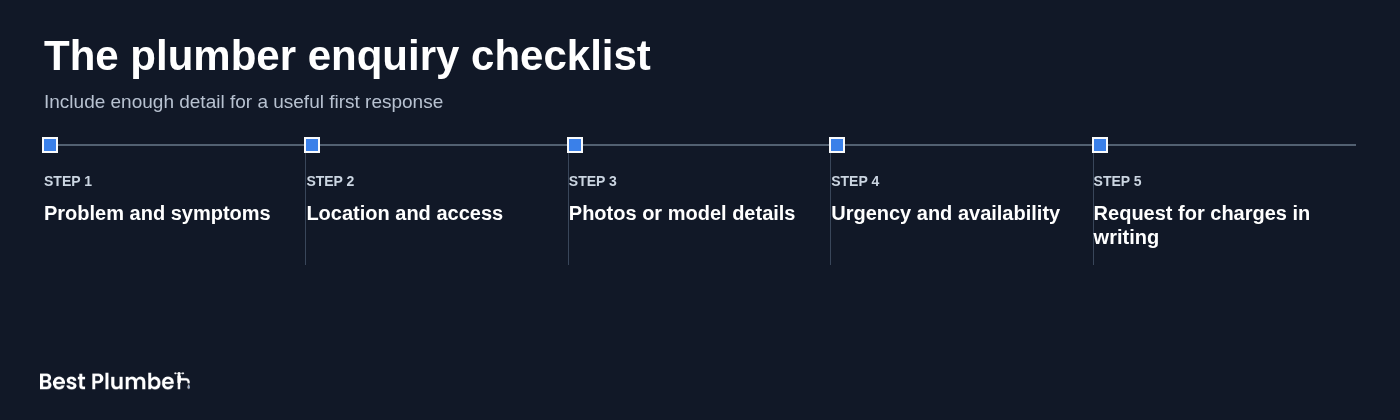
A good enquiry reduces guesswork. It also makes it easier to compare replies because each plumber is responding to the same basic information.
Include the symptoms, the exact location, when the problem started, what has already been tried, property type, access constraints, your desired outcome and the level of urgency. Photos and short videos can be valuable, but they do not replace an on-site diagnosis when the cause is uncertain.
Remote quotes are often provisional for fault-finding. A plumber may need to inspect pipework, test a system or remove a panel before identifying the root cause. That is normal, provided the inspection cost and next approval point are clear.
What to include in photos and videos
Send a wide image to establish the room and access, then close images of the affected fitting, pipe, valve or appliance. For a leak, include the surrounding area as well as the visible drip; staining or moisture patterns can help explain the scale of the issue.
For appliances and boilers, include model and serial information where it is safely accessible and relevant. A short video can show an intermittent noise, toilet flush problem, pressure reading or leak pattern more clearly than a description alone.
Do not photograph personal documents, keys, alarm panels or details that expose unsafe access points to your home. Never climb into unsafe loft spaces or confined areas just to obtain a better image.
A copy-and-send message template
You can adapt this message when contacting local plumbers:
Hi, I need help with [brief problem] at a [house/flat] in [area or postcode]. The issue began [time/day] and is [getting worse/stable/intermittent]. It is located at [location in property]. I can provide photos/video and access is [details, such as parking, tenant access or restricted hours]. Please let me know your earliest availability, call-out or inspection terms, how you provide estimates, and whether you have the relevant credentials for this work. If possible, please confirm charges and any travel or emergency premiums in writing.
This does not force a final price from incomplete information. It gives the professional enough detail to explain what they can offer and gives you a written starting record.
Understand plumber pricing before you agree to a visit
There is no single normal price for plumbing work. Region, timing, access, job complexity, materials and urgency all affect the total. What matters is understanding the pricing structure before an appointment turns into a surprise bill.
Ask whether there is a call-out fee, minimum labour charge, hourly rate, fixed price, materials markup, parking cost, travel cost or emergency premium. For planned work, request this information in writing so you can compare responses fairly.
What a normal call-out fee can and cannot tell you
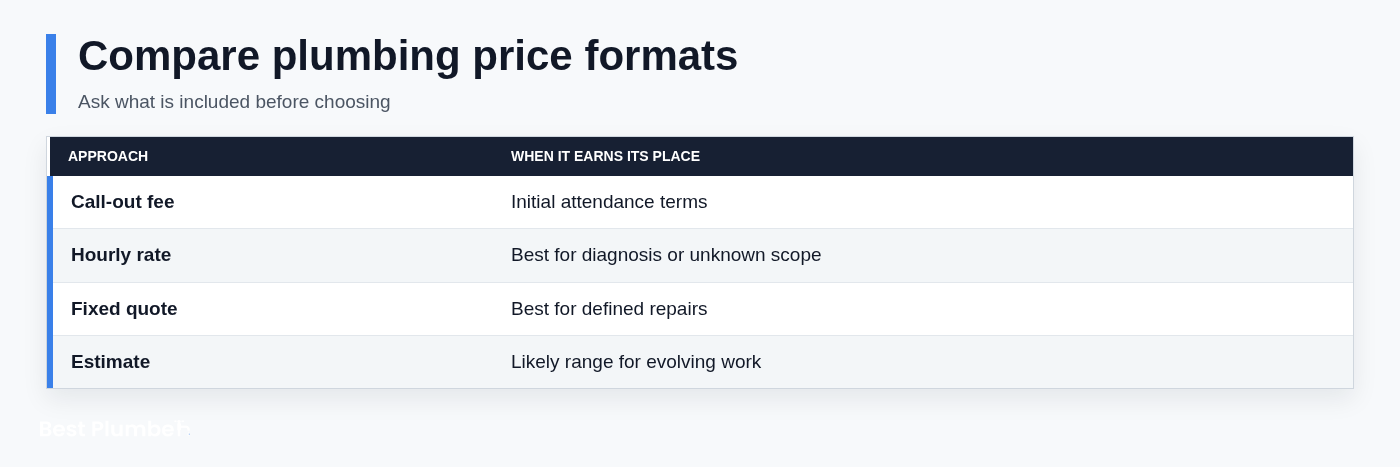
A low call-out fee can look attractive, but it says very little by itself. One provider may include travel and the first block of labour; another may charge a call-out fee, travel and labour separately. Some use the fee mainly to cover inspection, then quote for repairs afterward.
Ask what the initial visit includes, how long it covers, whether diagnosis time is chargeable and what happens if parts are needed. Compare the expected cost of the first visit, not just the headline figure.
Fixed quote, estimate or hourly rate: choose the right basis
A fixed quote is an agreed price for a defined scope of work. It is often best for straightforward repairs or installations once the work is understood. Check exactly what is included and what assumptions the quote relies on.
An estimate is a likely price range, not usually a final binding total. It is useful for larger projects or work that may develop after inspection, but you should ask what could cause the cost to move beyond the range.
An hourly rate is often appropriate for diagnosis and unknown faults. It can be fair, but set a spend limit or decision point. For example: approve up to the first hour for investigation, then require a call or written message before further chargeable work begins.
Compare quotes on scope, exclusions and accountability
The cheapest quote is not automatically the lowest-cost option. It may exclude materials, disposal, testing, making good, access equipment, certificates or return visits. A more expensive quote may include work that would otherwise appear later as extras.
For substantial work, get the scope in writing. It should identify the work to be completed, included materials or allowances, major assumptions, likely start date, payment schedule and how changes will be handled.
The quote comparison checklist
- Labour and materials, including whether fixtures are supplied by you or the contractor.
- VAT status and whether the stated figure includes it.
- Access assumptions, parking, travel, scaffolding or other site requirements where relevant.
- Removal and disposal of old fittings, packaging and waste.
- Testing, commissioning and any certificates needed for the work.
- Warranty or workmanship terms and who to contact if a defect appears.
- Proposed timetable, start date and expected disruption.
- Payment terms, deposit amount and milestones for larger projects.
Compare like for like before negotiating. If one quote includes a new valve, testing and making good while another simply says "repair leak," the lower number is not a true comparison.
Use a decision scorecard for high-stakes plumbing work
For a costly bathroom project, major heating change or urgent repair with several credible options, a simple scorecard can make the decision less emotional. It will not guarantee quality, but it forces you to compare evidence rather than choosing solely on price or a persuasive phone call.
Score each candidate against the factors that reduce risk
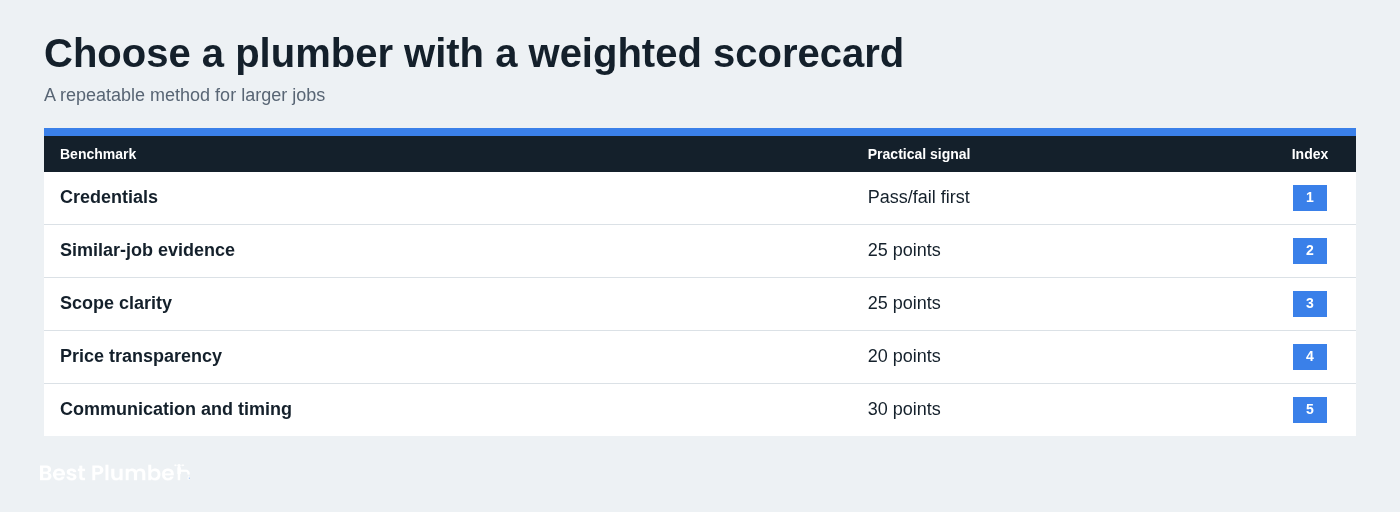
First apply non-negotiable gates. If the work involves gas, appropriate Gas Safe registration must be verified. If a provider cannot explain their scope, provide business details or meet essential availability needs, do not try to score around that problem.
For the remaining candidates, score each area against the same criteria. A practical weighting is: similar-job evidence, 25 points; scope clarity, 25 points; price transparency, 20 points; communication and timing, 30 points. Total the score out of 100 and keep short notes explaining each mark.
For example, imagine two bathroom plumbing quotes. Candidate A is cheaper but gives a one-line description, leaves waste removal unclear and cannot confirm a start date. Candidate B costs more but specifies fixtures, pipework changes, testing, disposal, a staged payment plan and a realistic schedule. Candidate B may represent better value because the cost, responsibility and likely outcome are clearer.
Confirm the booking and protect yourself during the job
Once you choose a provider, confirm the essentials in writing: appointment date and arrival window, contact details, access arrangements, the agreed job, expected pricing basis and who supplies materials. For larger work, record milestones and what happens if new issues are discovered.
Payment should reflect the size and nature of the job. It is sensible to be cautious about demands for full payment before substantial work has been completed, especially when the scope is large. Use a payment method that leaves a record and retain all invoices.
Agree the approval process for extra work
Plumbing problems can reveal hidden issues behind walls, under floors or inside a heating system. The discovery itself is not necessarily a red flag. The important question is how the provider handles it.
Ask for an explanation of the issue, the available options, the cost and time impact, and whether the original approach is still viable. Where practical, request written approval before additional chargeable work proceeds. This protects both sides from misunderstandings.
Keep records that support a warranty or complaint
Keep the quote or estimate, messages, photos before and after work, invoices, payment confirmation, certificates and warranty information. Store them together rather than relying on a text thread that may be difficult to find months later.
Documentation matters if a fitting fails, a warranty claim is needed or you need to challenge work that does not match the agreed scope. It also makes future maintenance easier because another professional can see what was installed or repaired.
Inspect the finished work before signing off
Do a practical handover check before treating the work as complete. Test the repaired tap, toilet, shower, appliance connection or radiator while the plumber is still present if possible. Look for leaks, unusual noises, poor drainage, loose fittings or damage to surrounding finishes.
Ask how to operate relevant controls and isolation valves, particularly after boiler, heating or bathroom work. Confirm whether any certificates, manuals, test results or warranty documents should be provided, and make sure the work area has been left in the agreed condition.
If you notice a visible issue, raise it promptly and in writing. Be specific about what you observed, include photos where helpful and refer back to the agreed scope. Early, clear communication gives the provider a fair chance to resolve the problem.
Red flags that should make you pause or walk away
One concern may simply need a direct question. Several concerns together are a strong reason to choose another provider.
- Gas credentials cannot be verified for gas-related work.
- The scope remains vague despite reasonable questions.
- The provider refuses to explain pricing terms or provide anything in writing.
- There is pressure to decide immediately when the situation is not an emergency.
- They insist on cash-only payment without an invoice or clear business record.
- A large upfront payment is requested without a clear reason, contract or milestone plan.
- Reviews show recurring complaints about hidden charges, missed appointments or unresolved defects.
- The person attending cannot identify the business, work scope or relevant qualifications.
Trust your judgment, but base it on evidence. A professional should be able to explain what they know, what they need to inspect and what you will be asked to approve before costs increase.
Find the right local plumber with a clearer process
The best way to find a good plumber is not to chase the first available name or the lowest advertised call-out fee. Classify the job, search locally with a sensible radius, verify job-specific credentials, compare written scope and pricing, and keep a record of what you agree.
That process is quick enough for most urgent situations and much more valuable for planned work. It helps you distinguish a suitable local professional from a listing that simply happens to be nearby.
When you are ready to begin building a local shortlist, use BestPlumber to search by area and contact relevant local plumbing providers.