
A plumber's workmanship guarantee should be in writing before you pay the final balance. There is no single UK-wide "standard warranty" period for every plumbing job, so a verbal promise such as "I'll guarantee it" is not enough unless it says exactly what is covered, for how long, and what the plumber will do if something fails.
The most useful paperwork is not necessarily the longest document. It is a clear quote, a matching job description and a guarantee that identifies the work completed and the remedy available if the workmanship proves defective.
What a plumber workmanship guarantee should include in writing
A workmanship guarantee covers the quality of the plumber's labour and installation. It should explain what happens if work they carried out develops a fault because it was installed, connected, repaired or tested poorly.
That is different from a manufacturer's warranty. A boiler valve, tap, shower pump or other supplied part may have its own manufacturer warranty, often subject to separate registration and conditions. A component can fail despite being fitted properly; equally, a sound component can fail because it was installed incorrectly. Your documents should make that distinction clear.
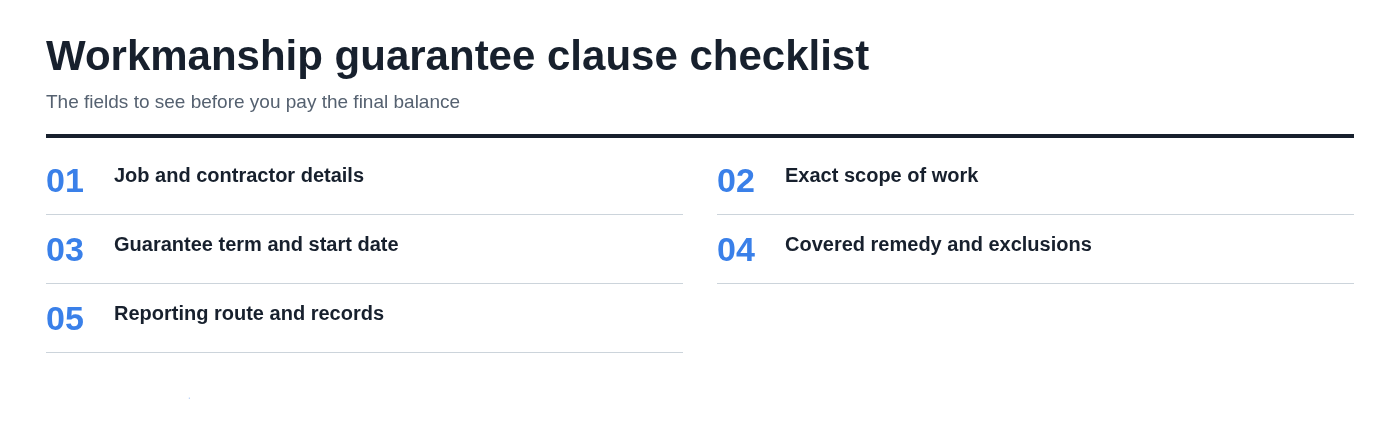
Before final payment, ask for written terms that identify the completed work, the guarantee period, covered defects, exclusions and the repair process. If the work changes during the job, the updated scope and price should be recorded too. Otherwise, it becomes much harder to establish what the plumber actually agreed to do.
The details to ask for before you accept the quote
Get the core job terms agreed before work starts, not after a leak, delay or disagreement. The quote, specification and guarantee should all describe the same work so that exclusions cannot quietly appear later.
- Scope of work: the fixtures, pipework, connections, repairs, tests and reinstatement included.
- Materials: key products, brands or specifications where they matter, and whether the plumber or homeowner supplies them.
- Price: a fixed price or estimate, with a clear explanation of what could change it.
- Timing: expected start date, completion date and any access requirements.
- Payment stages: deposit, interim payments and the point at which the final balance is due.
- Who will do the work: the named trader, employees or subcontractors.
- Extra charges: whether VAT, call-out fees, parking, waste disposal and making-good are included.
"Making-good" deserves particular attention. Replacing a concealed pipe may require lifting flooring, opening a wall or removing a unit. A repair quote may cover the plumbing but not plastering, tiling, decorating or refitting cabinetry. That is not automatically unreasonable, but it should be explicit.

The 8 points a workmanship guarantee clause needs
A useful guarantee clause is specific enough that both sides can identify the installation and understand the remedy. Use the following points as a checklist when reviewing a proposed workmanship warranty template or an email from the plumber.
1. The contractor and job address
The document should state the trader's legal name, business address and contact details. If the business is a limited company, include the company number where applicable. It should also show the address where the work was carried out.
A trading name on its own may not tell you who is responsible if you need to contact the business later. Match these details to the quote, invoice and payment recipient where possible.
2. A precise description of the work
The guarantee should refer to the actual completed scope, not a vague phrase such as "bathroom plumbing work." It should identify relevant fixtures, pipe runs, connections, repairs, pressure testing, commissioning and any agreed reinstatement.
For example, "replace the cold-water feed from the stopcock to the kitchen sink, fit isolation valves and test for leaks" is much more useful than "repair kitchen leak." It separates the agreed work from informal suggestions or estimates discussed on site.
3. The workmanship guarantee period and start date
Ask for a stated period and a clear start date. Does it begin when the work is completed, when equipment is commissioned, or when the invoice is paid? A phrase such as "12-month workmanship guarantee" is incomplete if nobody can tell when the 12 months started.
The stated guarantee period does not remove your legal rights where a service was not performed with reasonable care and skill. It is still worth getting the extra contractual promise clear, because it sets expectations for dealing with faults.
4. What defects and remedial work are covered
The clause should explain what counts as a covered workmanship defect and what the plumber will do. Ideally, it confirms whether diagnosis, labour, replacement materials, access and re-testing are included when the issue is caused by the original work.
Be cautious with wording like "all work guaranteed" when it does not say what the remedy is. A meaningful guarantee should commit the trader to investigate and rectify a covered defect within a reasonable process, rather than merely acknowledging that a problem exists.
5. Parts and manufacturer warranty information
List important supplied products and retain their model and serial numbers where useful. Keep manufacturer warranty documents separately, including any registration instructions and maintenance conditions.
This matters because responsibility may differ depending on the cause. A defective tap cartridge may be a product issue, while a tap leaking because the fitting was not sealed correctly may be a workmanship issue. Clear records make that conversation far easier.
6. Exclusions and conditions
Exclusions should be written in plain language. Common examples can include accidental damage, misuse, freezing, lack of required maintenance, later alterations by another person, or pre-existing problems outside the agreed scope.
Some exclusions are sensible; no plumber can guarantee pipework damaged later by a builder or tenant. But broad wording that excludes "all consequential issues," "all existing plumbing" or anything the trader decides is outside their control may make the guarantee nearly worthless. Ask for clarification before accepting it.
7. How to report a problem and the response process
The terms should give you a contact route and explain what information to provide, such as photographs, a description of the fault and the date it appeared. It is also helpful to know how quickly the plumber expects to acknowledge a report and how access for an inspection or repair will be arranged.
If there is an active leak or a safety concern, take reasonable urgent steps to limit damage and keep records of what happened. What to do while waiting for an emergency plumber can help with immediate practical steps. Photograph the problem, save messages and retain invoices for any emergency action. Do not assume you must let damage worsen while waiting for a routine response.
8. Date, acceptance and supporting certificates
Date the guarantee and keep it with the signed quote or email acceptance, invoice, proof of payment and photographs of the completed work. A signature is helpful, but an email confirming the agreed terms can also provide a useful record.
Some jobs may also require specific documentation, depending on the work involved. Retain any relevant gas, electrical, appliance or building-control paperwork alongside the plumbing records rather than relying on a single folder held by the trader.
A plain-English workmanship warranty clause example
The following is an illustrative clause, not a one-size-fits-all legal template. It should be tailored to the actual job; copying a generic workmanship guarantee template without adding the specific work can create more uncertainty, not less.
Example: "The Contractor guarantees the workmanship involved in [describe the completed plumbing work at the property address] for [stated period] from [completion/commissioning date]. If a defect arises during that period as a direct result of the Contractor's workmanship, the Contractor will, following notification at [email address/telephone number], inspect the issue and rectify the covered defect within a reasonable time. This guarantee covers the reasonable labour and materials required for that rectification. It does not cover manufacturer defects, accidental damage, misuse, freezing, lack of required maintenance, unauthorised alterations by others, or defects in existing plumbing not included in the agreed scope. Product warranties remain subject to the relevant manufacturer's terms."
The value lies in the brackets being completed accurately. If the work involved a new shower waste, replacement pipework and a pressure test, say so. If it was only a repair to one leaking joint, do not let the wording imply a guarantee over an entire ageing system.
How long should a plumber guarantee their work?
There is no universal standard warranty for plumbing work in the UK. The appropriate period depends on the nature of the job, the materials used and how much of the system the plumber controlled.
A small repair to an old installation is not comparable with a planned installation or substantial pipework alteration. In the first case, the plumber may reasonably guarantee the repair itself without guaranteeing unrelated ageing components. In the second, a longer or more detailed commitment may be appropriate because the work is more defined and the installation has a greater role in its future performance.
Do not choose solely on the longest headline guarantee. Compare what is actually covered, whether labour and access are included, the exclusions, and whether the quoted scope is sufficiently detailed. A realistic, enforceable remedy is usually worth more than an impressive-sounding term with extensive exceptions.
Know the difference between a guarantee, warranty and your legal rights
A workmanship guarantee is an additional promise from the plumber about their labour. A product warranty usually comes from the manufacturer of an appliance or component and may have its own claim process.
Separate from either document, the Consumer Rights Act 2015 provides that services supplied to consumers should be performed with reasonable care and skill. That principle can matter if the work is defective even where a trader has offered no written guarantee, although the facts of each case matter and this article is not legal advice.
Do not assume that every plumbing job needs the same certificates. Particular work involving gas, electrical connections, appliances or building regulations may require relevant documentation, while a straightforward plumbing repair may not. Ask the contractor what paperwork applies to your specific job and retain it once issued.
What to do if the plumber will not put the guarantee in writing
Ask for the guarantee terms by email before you commit to the job or release the final payment. A short written confirmation is better than no record at all, provided it identifies the work, duration, exclusions and remedy.
If the plumber will not clarify a vague scope or refuses to state what happens if their work fails, consider pausing. That does not prove the trader will do poor work, but it leaves you with avoidable uncertainty. For a significant installation or repair, it is reasonable to seek a clearer quote or compare another provider.
Keep the quote, messages, photographs, invoices, payment records and any certificates throughout the job. If a defect arises, notify the trader in writing, describe the issue and give them a reasonable opportunity to inspect and remedy it where appropriate. If the same issue returns, see what to do if the same plumbing problem comes back after repair. If that does not resolve the matter, obtain independent evidence where needed and consider suitable consumer advice or dispute-resolution routes.
Keep a complete plumbing work record
Your practical file should contain the written quote, scope of work, workmanship guarantee, invoice, payment proof, product paperwork, before-and-after photographs and any relevant completion certificates. Save emails and text messages that record changes to the job or promises made during it. For a useful follow-up after the work, review what to check after a plumber repairs a leak.
The strongest protection is a clear scope paired with a realistic remedy, not a verbal assurance that everything is "guaranteed." If you are looking for a local plumber, use BestPlumber to find and contact providers, then request the written terms before authorising work or booking the job.