
A lead service line can sit quietly in an older house for decades, even after the kitchen and bathrooms have been updated. That is why a shiny new tap or modern plastic pipe under the sink does not automatically mean the whole water supply is lead-free.
This guide focuses on UK homes. Installation dates, pipe responsibilities, testing guidance, and terminology may differ elsewhere.
You can safely inspect accessible pipework and collect useful clues, but visual checks are only the starting point. The most reliable answer comes from proper water sampling and, when needed, advice from your water supplier or a qualified plumber.
Start with safety: do not disturb or alter a suspected lead pipe
Look closely at exposed pipework, but do not scrape, cut, disconnect, drill into, or sand a pipe you think may be lead. Abrasive testing can damage the pipe, create debris, and turn a simple inspection into a plumbing problem.
The concern with lead plumbing is lead getting into drinking water. The amount can vary depending on the pipework, water chemistry, how long water has been sitting in the pipes, and whether work has recently disturbed an old line. A pipe's appearance can suggest a risk, but it cannot tell you the level of lead in your water.
Use an inspection to decide whether you need the next step: guidance from your water supplier, a lead-in-water test, or an inspection by a qualified plumber. If there are infants, young children, or pregnant people in the household, move more quickly to testing and temporary exposure-reduction steps.
Know which pipe you are trying to identify
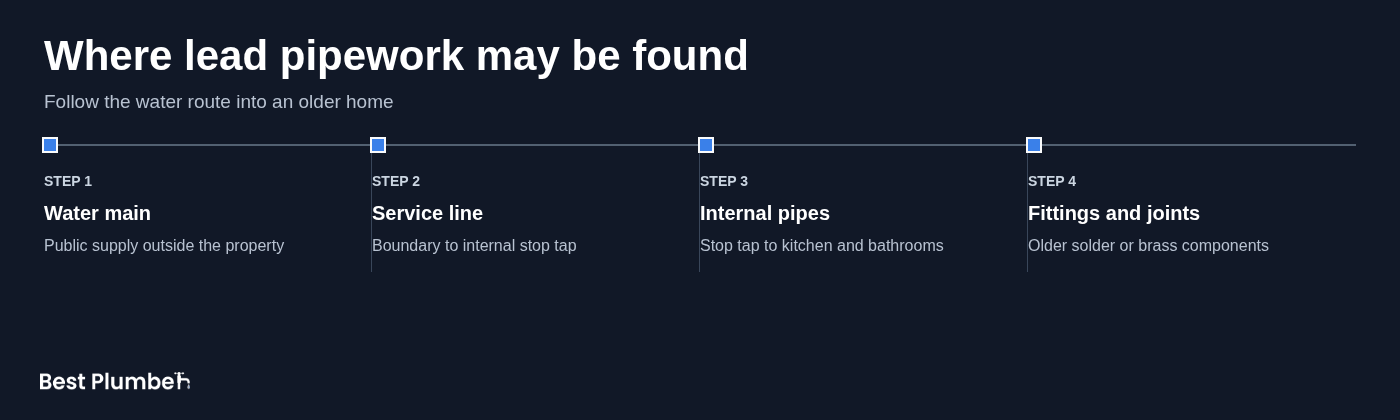
Before inspecting, it helps to follow the route water takes into your home. The pipe that matters most is often the service line: the supply pipe running from the public water main toward your property and internal stop tap. In an older house, part of that line may be underground and out of sight.
After the internal stop tap, the water travels through your home's internal supply pipes to the kitchen, bathrooms, boiler, and other outlets. These may have been replaced over time even if an older lead section remains before the stop tap. You may also see old soldered joints or brass fittings; their presence alone does not prove that lead is entering the water.
Mixed pipework is common. For example, a house might have copper pipes under the kitchen sink, plastic pipework to an upstairs bathroom, and an older lead service line entering the building below the floor.
Pipe material is a useful clue, not a measurement of water quality. Testing is still important if lead is suspected.
Use the age of the property as a clue, not proof
In the UK, lead water pipes were banned for new installations in 1970. That means homes built before 1970 are more likely to have original lead service lines or internal lead pipework. But the build year is not a diagnosis: many older homes have had their pipes replaced, while later alterations can leave an older section in place.
A 1950s home may have lead pipes, particularly between the water main and the internal stop tap. It may also have had a full or partial replacement during renovation. Ask previous owners, your landlord, managing agent, or solicitor for records of water-supply work if they are available.
Do not assume a renovation solved the issue. Refitting a kitchen often replaces only the visible pipes in that room. The buried supply line, pipework behind walls, or sections entering through a cellar may remain untouched.
Find the incoming water pipe and internal stop tap
Start indoors. In many UK homes, the internal stop tap is under the kitchen sink, but it may be in a utility room, airing cupboard, cellar, garage, downstairs toilet, or a cupboard near the front of the property. For more guidance, see how to find the internal stopcock in your home. Bring a torch and take your time rather than moving stored items aggressively or forcing access panels.
Find the valve that turns off the cold-water supply, then look at the pipe immediately on the street side of that stop tap. This is often the most useful accessible section to inspect when you are trying to identify a possible lead service line.
Trace the pipe visually as far as you can. It may disappear through a wall, floor, or cellar ceiling near the point where water enters the home. Take photographs from several angles, including the pipe, joints, stop tap, and any visible markings. Clear photos are useful if you later ask a plumber or water supplier for an opinion.
If you rent, ask your landlord or managing agent before accessing locked cupboards, concealed voids, meter areas, or building-service spaces. Do not remove fixed panels or lift flooring to investigate.
Check the pipe's colour, shape and surface
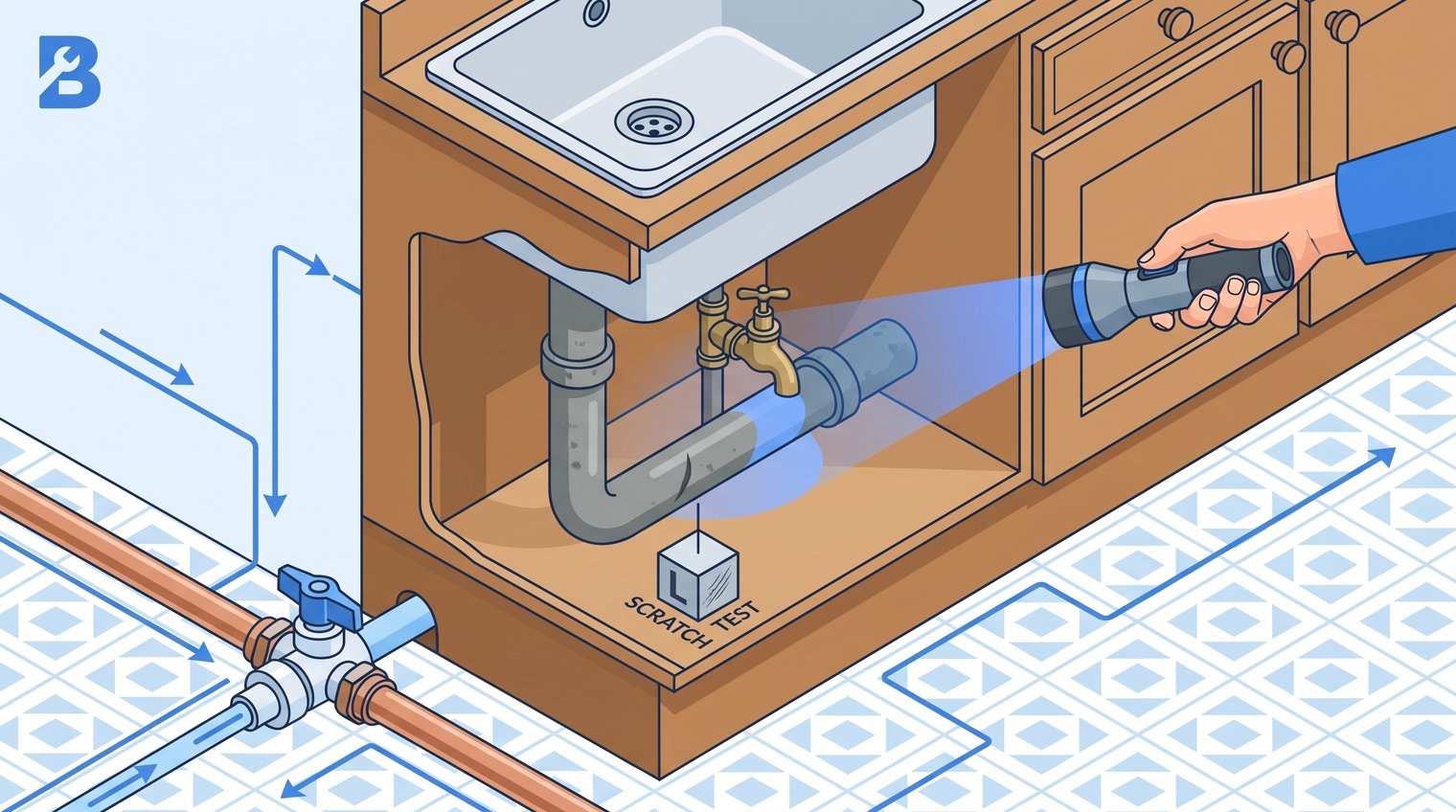
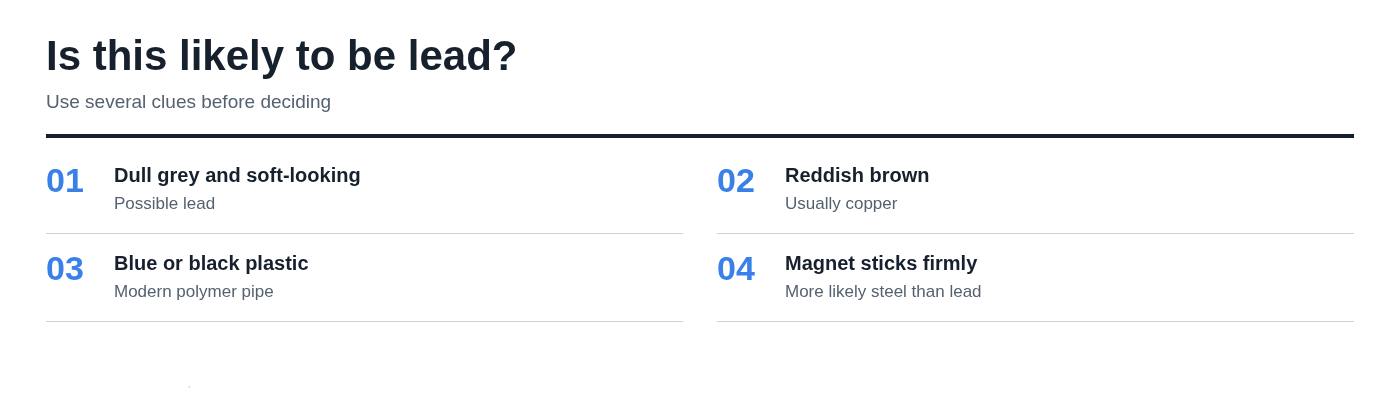
Lead pipes are often dull grey and can look soft or slightly uneven compared with modern pipework. Older lead was shaped by hand, so a pipe may have gentle irregularities, broad bends, or a less uniform surface than a straight copper or plastic pipe.
Common alternatives look different:
- Copper: usually reddish-brown, orange-brown, or darkened with age. It is generally smooth and uses tidy fittings.
- Plastic: commonly blue or black for water supply pipework. Modern plastic pipe is usually uniform and clearly manufactured.
- Galvanised steel: grey, hard, and often corroded or threaded at joints. Unlike lead, it may attract a magnet.
Visual identification has limits. Paint can hide the original surface, corrosion can change colour, and poor lighting can make copper, steel, and lead hard to distinguish. Do not decide based only on colour, and do not use the modern material of nearby pipes as evidence that the incoming line is safe.
Look for the characteristic swollen or wiped joint
Older lead pipework sometimes has hand-worked, bulbous-looking bends or joints. These can appear thicker and less neat than the compression fittings commonly used on copper and plastic pipework.
That feature can support a suspicion of lead, but it is not essential. Some lead sections are relatively plain, and a visible joint can have been replaced while another hidden section remains. Treat every clue as part of the picture rather than a final answer.
Use simple non-damaging checks to narrow it down
A small magnet can help rule out one common material. Hold it against an accessible pipe section: if it sticks firmly, the pipe is more likely to be steel than lead. A magnet will not stick to lead or copper, so a non-stick result does not confirm lead.
If an unpainted section is already exposed, you can gently wipe it with a damp cloth to remove ordinary surface dirt. Lead may show as a dull grey surface underneath. Do not scratch it with a key, knife, wire brush, or sandpaper. The common mistake is treating an old pipe like a DIY material sample; the correct approach is to observe without damaging it.
Take photos before contacting anyone. Include a wider image that establishes the location, then close-ups of the pipe and fittings. A plumber can often tell you whether an in-person inspection is warranted, while your water supplier may explain what it knows about the public-side supply.
Inspect outside only where it is safe and visible
You may be able to see part of the supply near an external stop valve, water meter box, boundary area, cellar entry point, or where the pipe enters the outside wall. Inspect only what is already visible and easy to reach.
Do not dig beside the property, open utility infrastructure, remove meter covers beyond normal permitted access, or interfere with a stop valve. Underground pipework can be fragile, and the visible material near the house may not match the material farther along the service line.
Responsibility can also be split. The pipe from the public main to the property boundary is commonly the water company's responsibility, while responsibility beyond that point varies by water supplier, property type, and local arrangement. If the external section is inaccessible or you suspect it is lead, contact your water supplier for the appropriate next step.
Confirm suspicion with a lead-in-water test
Water testing is the reliable way to check whether lead is present at a level of concern. This is particularly important if the home has a suspected lead service line, old internal pipework, or occupants who are more vulnerable to lead exposure, including babies, young children, and pregnant people.
Lead has no dependable taste, smell, or colour. Clear water is not proof of safe water, and discoloured water is not a specific sign of lead. You cannot identify lead in water by looking at it or tasting it.
Your water supplier may provide guidance, arrange sampling in some circumstances, or explain local replacement support. You can also use an accredited laboratory test where appropriate. Follow the instructions from the supplier or laboratory exactly, because the way you collect the sample affects what the result means.
Choose the right sampling approach
A first-draw sample is generally taken after water has sat in the plumbing for a specified period, often overnight or for several hours. It can help show what may dissolve into water while it is standing in household pipes.
A flushed sample is taken after the tap has run for the instructed time. Comparing it with a first-draw sample may help indicate whether the likely source is closer to the tap, within internal pipework, or farther back in the supply. The exact method and timing should come from the laboratory or water supplier, not from guesswork.
Before ordering a kit, ask what lead threshold the report uses, whether it explains the result in plain language, and what follow-up help is offered if the reading is elevated. A test is most useful when you know how to act on the outcome.
Reduce exposure while you arrange confirmation or replacement
Until you have clearer answers, use only cold tap water for drinking, cooking, and preparing baby formula. Hot water can dissolve lead more readily, so do not use water from the hot tap for food or drinks.
After water has been standing for several hours, run the cold tap before filling a glass, kettle, saucepan, or bottle. Use freshly drawn water for anything you will consume. Your water supplier may give more specific advice for your area, including whether and how often to clean tap aerators.
Boiling water does not remove lead. In fact, because boiling reduces the volume of water, it can concentrate dissolved lead. Boiling is useful for some microbiological concerns, but it is not a solution for lead.
A filter may reduce lead only if it is specifically certified for that purpose and installed and maintained exactly as directed. Do not rely on a standard jug filter without checking its rated contaminant reduction and cartridge replacement schedule.
Arrange professional advice and plan replacement
Replacing the full lead service line is the durable solution when lead pipework is confirmed. It is worth discussing the whole route with both the installer and water supplier, because replacing only one section can have practical and water-quality implications that need proper planning.
When you speak with a plumber, ask for a clear assessment rather than a vague statement that the pipe "looks old." Use this checklist:
- Which visible and suspected sections are lead?
- Is the service line, internal pipework, or both affected?
- What access, excavation, wall entry, or reinstatement work is likely?
- Does the work require coordination with the water supplier or any local permissions?
- Will the installer recommend a post-work water test?
- Can the quote separate investigation, replacement, and reinstatement costs?
If you need local help, BestPlumber can help you find plumbers to contact for an inspection or replacement quote. You can also use this guide to finding a plumber locally. Share the photos you took and explain whether you have already spoken with the water supplier or completed a water test.
What to do when you suspect lead pipes
Start with the accessible incoming pipe near the internal stop tap. Note the colour, shape, joints, and whether a magnet sticks, then photograph what you find without scraping or altering anything.
Next, contact your water supplier or a qualified plumber, arrange a properly instructed lead-in-water test, and use cold, freshly drawn water for drinking and cooking while you wait for confirmation. If lead pipework is found, plan a full replacement conversation rather than assuming that replacing one visible section solves the issue.
An older property or a dull grey pipe is a reason to investigate, not a diagnosis. Confirmed sampling and a professional assessment give you the clearest basis for protecting your household and deciding what work is needed.