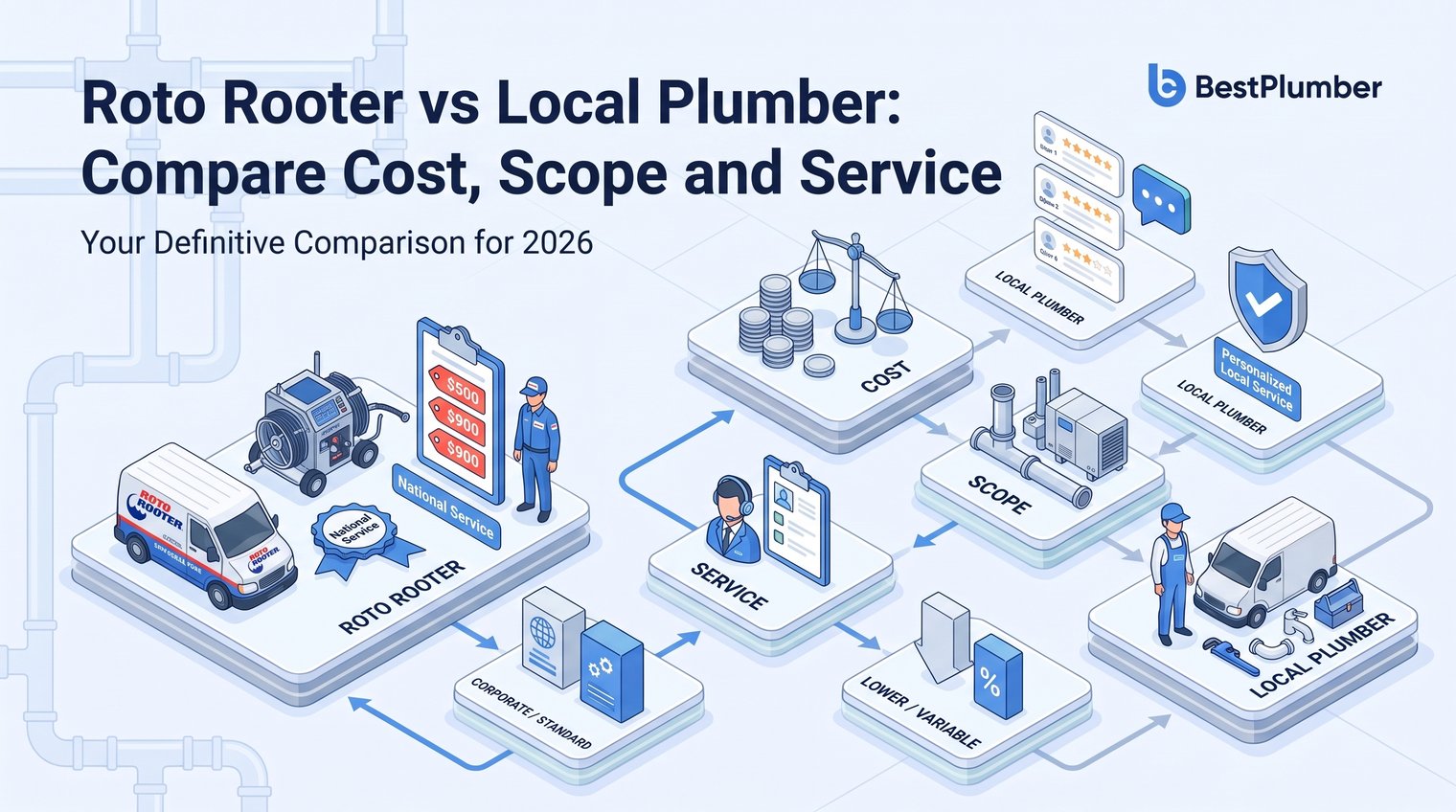
A blocked drain or leaking pipe creates the perfect conditions for a bad hiring decision: you are under pressure, the problem may be getting worse, and the first company that answers can seem like the obvious choice. But Roto-Rooter, where it operates, versus a local plumber is not a simple quality contest.
Both can be the right call. The useful distinction is usually between a national drain-and-emergency operation, with Roto-Rooter as an example where available, and an independently selected local plumbing business. Compare the actual job, response time, written scope, credentials, quote terms, and follow-up arrangements before relying on a familiar name or star rating alone.
The short answer: match the job to the provider
For a confirmed urgent blockage, a national drain specialist may be a sensible option if it can attend quickly, explains its charges clearly, and has the equipment suited to the problem. For broader plumbing repairs, planned work, or an ongoing relationship with one engineer, a local plumber is often the stronger fit.
Neither option is automatically cheaper, faster, or more competent. Service quality, availability, pricing practices, and the technician attending can vary by branch, postcode, job type, and individual business.
Quick verdict
Consider Roto-Rooter or another national drain-and-plumbing brand when an urgent drain issue needs a prompt, drain-focused response and the written estimate works for you. Choose a local plumber when you need diagnosis and repair beyond drain clearing, want to compare nearby quotes, or value continuity with the same business.
The deciding factor should be whether the provider can describe the fault, carry out the required work safely, state what the job will cost or may cost, and provide clear paperwork afterward.
What each option is designed to handle
The word "rooter" is commonly associated with clearing blocked drains and sewer lines. That does not mean a national drain company only clears drains, nor that every plumber handles every kind of drainage fault. It does mean you should begin by matching the company to the likely cause of the issue.
A plumbing business may deal with water supply pipes, taps, toilets, showers, leaks, fixture replacements, pumps, cylinders, and other household plumbing repairs. Some also provide drainage work, while others do not have the equipment or specialist experience for difficult external drains.
Always confirm the service menu with the local branch or individual business before booking. A company name tells you less than the technician's actual scope, availability, and equipment.
A national drain-and-plumbing brand, such as Roto-Rooter where available
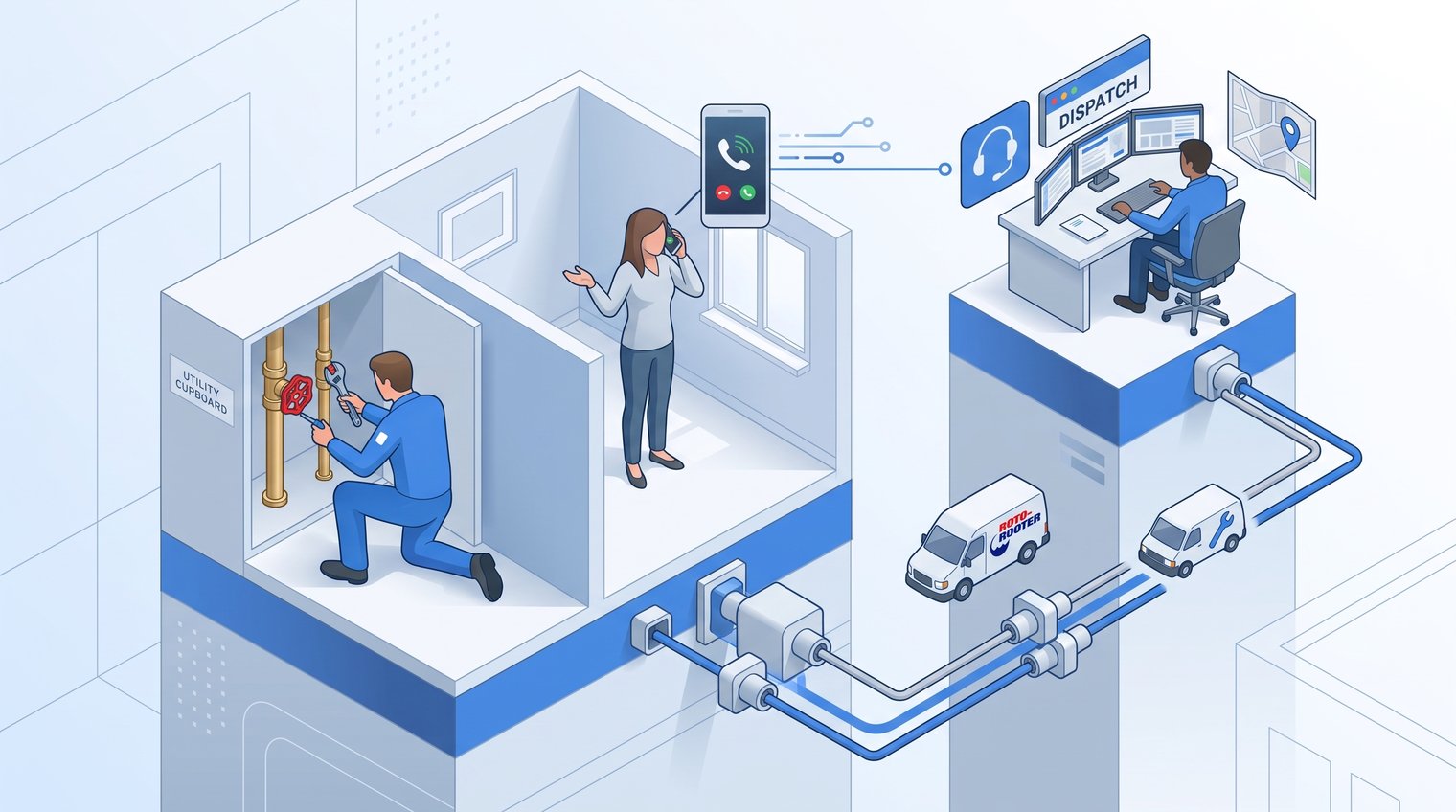
A national drain-and-plumbing brand can be appealing when you need a structured dispatch process and a provider that advertises drainage or emergency coverage in your area. Drain-clearing work may require equipment such as mechanical cleaners, jetting units, CCTV cameras, or locating tools, and larger operations may have wider access to those resources.
That can be especially useful when sewage is backing up, several fixtures are blocked, or an external drain appears to be involved. A branded call centre may also offer a clearer route for arranging attendance when you need help outside normal working hours.
The limitation is that the brand alone does not settle the important details. Confirm who will attend, what the call-out covers, whether the visit is diagnostic only, how additional work is approved, and what guarantee applies through the branch serving your postcode.
An independent local plumber
An independent local plumber can be a good fit when the job requires careful diagnosis followed by a repair: tracing a leak, replacing a failed valve, fixing a toilet, renewing pipework, or resolving a recurring issue in a home. Direct contact with the owner or assigned engineer can also make it easier to discuss the property's history and arrange follow-up work.
Local knowledge can matter too. A nearby engineer may understand common housing layouts in the area, have established suppliers, and be easier to call back if a repair needs checking.
Still, local does not automatically mean cheaper, better equipped, or available 24 hours a day. Ask about emergency cover, drain-specific equipment, insurance, labour rates, and the expected arrival window rather than assuming these points.
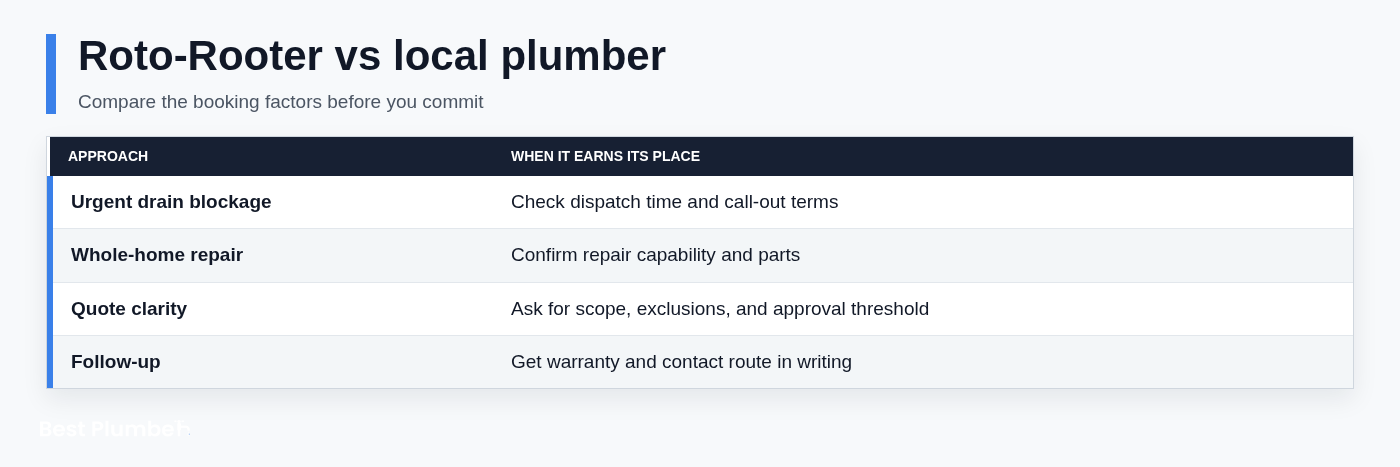
Comparison matrix: Roto-Rooter vs a local plumber
The table below is not a scorecard declaring one route better. Use it as a set of questions to verify before authorising work. The right answer can change from one job to the next.
| Booking factor | National drain-and-plumbing brand | Independent local plumber | What to verify |
|---|---|---|---|
| Best typical fit | Urgent drainage issues and drain-focused attendance | Broader repairs, planned plumbing, repeat household work | Does the provider regularly handle your specific fault? |
| Urgency | May offer central dispatch and advertised emergency cover | May offer local on-call service or limited hours | What is the actual arrival window and emergency rate? |
| Diagnosis | May have drain-specific equipment and processes | May offer hands-on property knowledge and repair planning | What evidence will support the diagnosis? |
| Price transparency | Terms can vary by local branch and job | Rates and estimates vary by business | What is included, excluded, and subject to approval? |
| Competing quotes | Usually less practical in an immediate emergency | Often easier for planned repairs | Can the issue safely wait long enough for comparison? |
| Continuity | Attendance may depend on dispatch arrangements | Often easier to request the same engineer or business | Who handles follow-up if the issue returns? |
| Specialist equipment | May be well suited to drain cleaning and inspection work | Varies significantly between plumbers | Does the proposed method fit the pipe and fault? |
| Warranty | May have branch-specific terms | May offer business-specific terms | Get the workmanship and parts warranty in writing. |
| Local coverage | Depends on the service area and available crew | Depends on travel radius and workload | Confirm attendance rather than relying on an online listing. |
Price: compare the total approved job, not the call-out headline
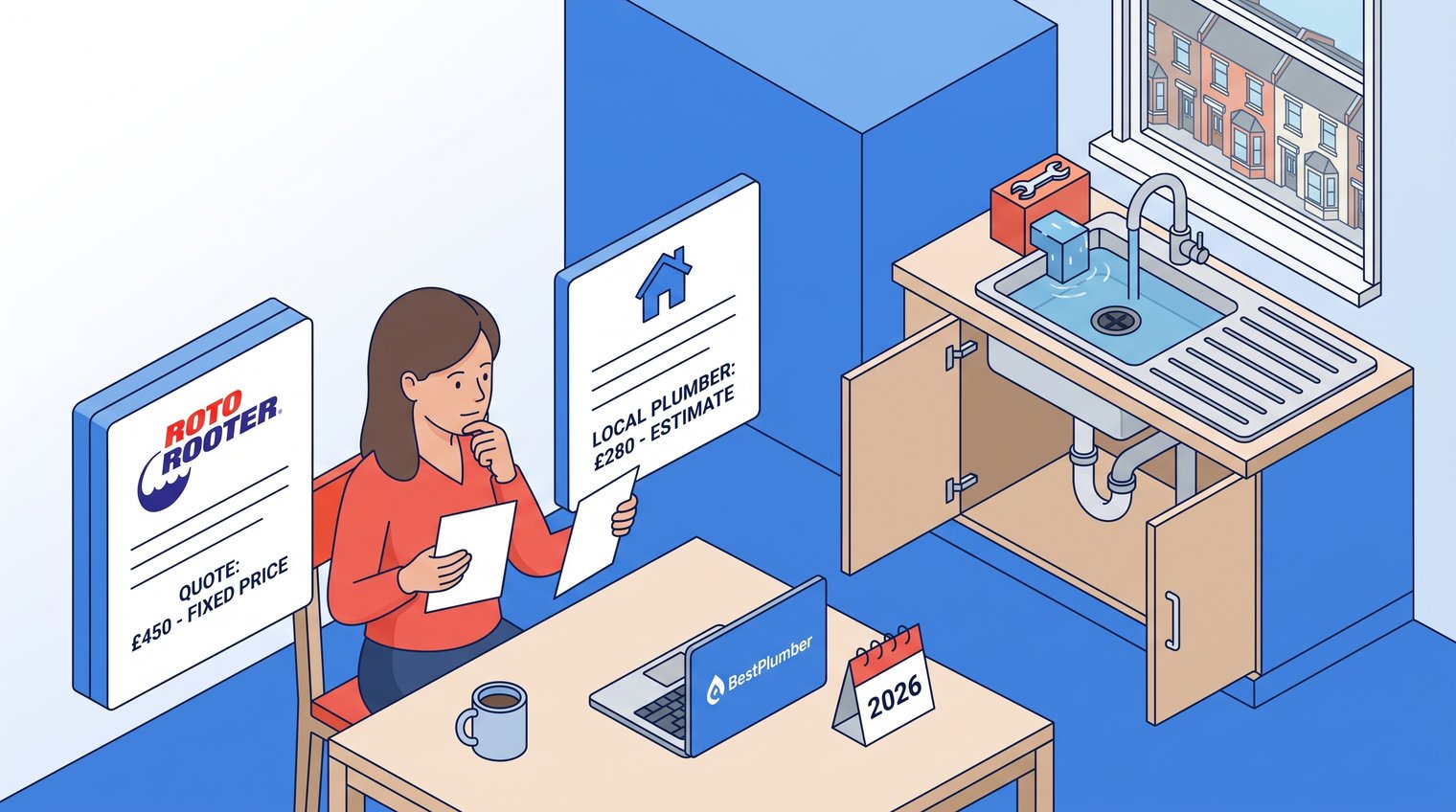
There is no universal answer to the Roto-Rooter versus local plumber cost question. This comparison is about pricing structure rather than universal amounts: the final bill depends on the fault, property access, time of attendance, equipment required, location, parts, and whether the first attempted fix solves the problem.
A call-out charge is only one component. Ask whether it includes diagnosis, labour, a set amount of drain-clearing work, travel, VAT, or any emergency uplift. If repair work is needed after the initial visit, the relevant comparison is the total approved job, not the lowest number mentioned during the first phone call.
A useful written estimate or price range should identify the expected method, main inclusions, exclusions, and the point at which the technician must ask for your approval before proceeding. This protects both sides when the underlying problem is not visible at the outset.
Why one quote can look cheaper before the work starts
A lower call-out can be legitimate, but it may not include the same work as a higher estimate. One provider may quote only for attendance and initial assessment, while another includes labour, standard clearance work, or a camera inspection.
For drain jobs, ask whether mechanical cleaning, jetting, CCTV inspection, access work, and disposal or restoration are included. For plumbing repairs, ask about parts, collection time, testing, and making good after access has been gained.
Also ask what happens if the first clearance attempt does not resolve the blockage. Will the provider stop and explain the next diagnostic step, or will additional equipment and labour be added automatically? You need a clear approval point before the scope expands.
Questions to ask before authorising extra work
- What has been diagnosed, and what evidence supports that diagnosis?
- What method will you use first, and why is it appropriate for my pipework?
- What does the quoted amount include?
- What could increase the bill, including after-hours charges, parts, access work, or further investigation?
- Will you seek my approval before spending more than an agreed amount?
- Will I receive an itemised invoice showing labour, materials, and any equipment charges?
If the problem is safe to delay and the proposed work is substantial, pause and get a second quote. That is not unreasonable; a reputable provider should be able to explain its findings and scope clearly enough for you to compare alternatives.
Emergency response and availability
Not every inconvenient plumbing issue is an emergency. A slow-draining sink or a dripping tap may be frustrating but can often wait for a normal daytime appointment. Active flooding, sewage backing up into the property, a suspected burst pipe, or loss of essential water are different situations and may justify urgent attendance.
A large dispatch network can be valuable when you need someone quickly, but it does not guarantee the fastest arrival in every postcode. A nearby independent plumber with an on-call arrangement may be closer and available sooner. Ask both routes for a realistic arrival window, not simply whether they offer "emergency service."
Before help arrives, take sensible steps to limit damage. Turn off the water supply at the internal stopcock if it is safe to do so, avoid using affected fixtures, move valuables away from leaking water, and keep children and pets away from contaminated sewage. Ask the provider whether there are safe immediate actions specific to your problem.
Equipment, diagnosis, and the risk of pipe damage
Drain-clearing tools can damage vulnerable pipework if used incorrectly or if the pipes are already badly deteriorated. But it is misleading to treat pipe damage as a risk tied to one provider category alone. The real factors are pipe material, age, condition, access, blockage type, and the tool and technique chosen by the operator.
Mechanical cleaning can be appropriate for certain obstructions. Hydro-jetting may be useful where a drain needs more thorough cleaning, while CCTV inspection can help investigate repeated blockages, root intrusion, displacement, collapse, or other defects. None of these methods should be presented as an automatic cure-all.
Ask the engineer to explain why the proposed method is suitable and what the alternatives are. If a damaged or collapsed drain is suspected, request evidence of the finding, whether footage can be supplied, and a written description of the recommended next step.
For a simple internal blockage
A proportionate approach usually begins with the accessible parts of the system. That may mean checking the trap, fixture, or nearby branch drain before escalating to invasive work. A blockage isolated to one sink may have a different cause from a problem affecting toilets, showers, and external drains at the same time.
Tell the plumber which fixtures are affected, when the symptoms began, whether water backs up elsewhere, and what has already been tried. Keep notes if the issue has recurred, especially after previous repairs or drain clearing.
For recurring blockages or suspected sewer-line defects
Recurring faults deserve more than repeated temporary clearance. Before approving major excavation, lining, or replacement, ask for documented findings, available footage, the likely cause, and the repair options. You should understand whether the recommendation addresses a local obstruction, damaged pipe, root ingress, poor falls, or a larger drainage issue.
Responsibility can be complicated. A fault within your property boundary may be your responsibility, while a shared or public sewer may involve the water company. Renters should contact their landlord or managing agent as well. Do not assume responsibility based only on where the symptom first appears inside the property.
Credentials, insurance, and accountability in the UK
Whether you choose a national brand or a local plumber, verify the business behind the booking. Ask for the company name, address or registered business details, public liability insurance, written terms, and a clear contact route if you need follow-up.
Relevant qualifications and trade memberships can be useful signals, particularly for specialised work, but they do not replace a proper scope and written price agreement. For gas work, Gas Safe registration is essential. It is not, however, a general credential for ordinary plumbing or drainage work.
Use reviews with more care than most people do. Look for recent feedback describing jobs similar to yours, details about punctuality and quote handling, and how the company responds when something goes wrong. A high average rating with vague comments is less useful than a pattern of specific, credible reports.
How to spot a quote you should question
Not every higher quote is an overcharge. Difficult access, hidden damage, after-hours attendance, specialist equipment, and a blockage that needs a different method can all add legitimate cost. The concern is not that a price changes; it is that it changes without evidence, explanation, or your approval.
Question a provider that refuses to state rates or even a workable scope, pressures you into major work immediately, gives a vague diagnosis without showing any evidence, insists on cash without paperwork, or will not provide an itemised invoice. You should also be cautious if there is no agreed spending limit for work discovered after arrival.
A professional may not be able to quote an exact final figure for an unseen fault. They should still be able to explain the starting charge, likely next steps, the factors that could alter the cost, and when they will stop for authorisation.
A fair hiring workflow for a local plumber
Use the same process whether you first contact a national drain company or begin with a local search. For more practical guidance, see How to Find a Plumber: A Complete Guide to Hiring Locally. Good decisions come from clear job information and comparable terms, not from trying to predict which type of provider is always best.
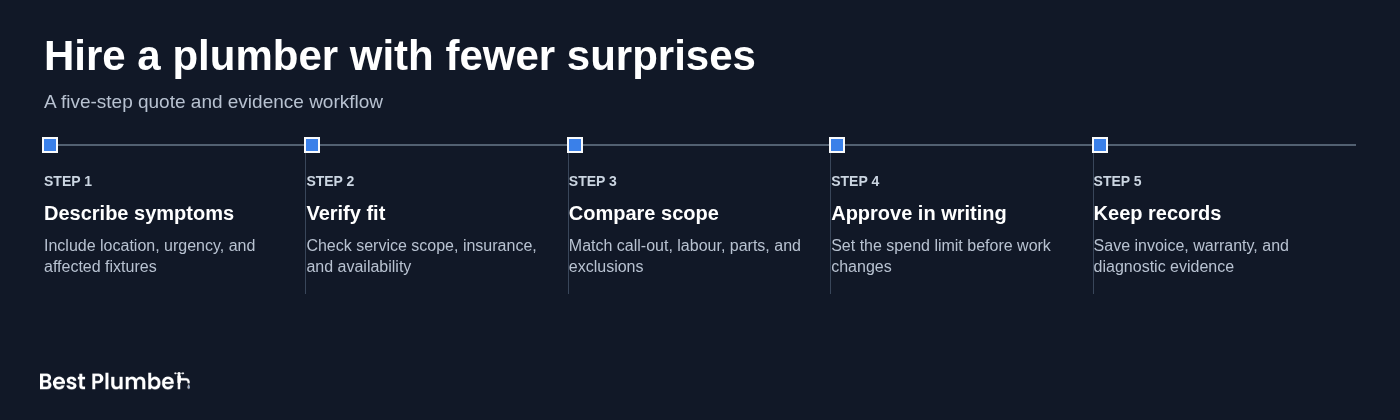
- Describe the symptoms clearly. State your location, the urgency, affected fixtures, when the issue began, and whether water, sewage, or a leak is actively causing damage.
- Prepare evidence. Take photos or short videos where safe, and note previous repairs, recurring symptoms, and any access constraints.
- Verify the fit. Confirm the provider handles the type of work, has suitable availability, and carries appropriate insurance.
- Compare scope, not just totals. Match call-out terms, labour, materials, drain-clearing method, VAT, exclusions, and emergency charges.
- Approve changes in writing. Set a spending limit and require contact before work moves beyond the initial agreed scope.
- Keep the paperwork. Save the itemised invoice, diagnostic evidence, warranty details, and contact information for future reference.
If you are looking for nearby businesses, BestPlumber can be used to start a location-based shortlist of local plumber listings. It is a discovery tool, not a guarantee of a provider's quality, price, availability, or suitability. Apply the same checks to every business you contact.
Choose Roto-Rooter when these needs matter most
Choose a national drain-and-plumbing brand such as Roto-Rooter when a confirmed blockage or drainage issue needs urgent attention, advertised round-the-clock availability matters, and the provider operates in your area. It may also be the practical choice when you need drain-focused equipment and cannot safely wait to gather multiple quotes.
Even then, make four checks before authorising more than the initial visit: ask who is attending, confirm the total-cost terms or approval threshold, understand the diagnostic method, and get warranty details in writing. Fast dispatch is valuable, but it should not replace a clear scope.
Choose a local plumber when these needs matter most
Choose a local plumber when the work involves broader household plumbing, a planned repair, fixture replacement, ongoing maintenance, or an issue where you want to compare several nearby businesses. This route is also well suited to homeowners who value using the same engineer for future work and follow-up.
Verify emergency availability, specialist drainage equipment, insurance, and pricing provider by provider. A local plumber may be the best person for the job, but only if their actual service offering matches the problem in front of you.
Make the final choice on evidence, scope, and written terms
The best choice is not automatically Roto-Rooter or automatically a local plumber. Pick the provider that can document the diagnosis, complete the correct scope safely, attend within the timeframe your situation requires, and state the price and warranty clearly.
Pick a national drain specialist if you need a prompt response to an urgent drain problem and its confirmed terms make sense. Pick a local plumber if you need wider repair capability, comparable local quotes, or an ongoing service relationship. For a UK location-based shortlist, use BestPlumber, then make the final booking only after checking the evidence, scope, and written terms.